Introduction
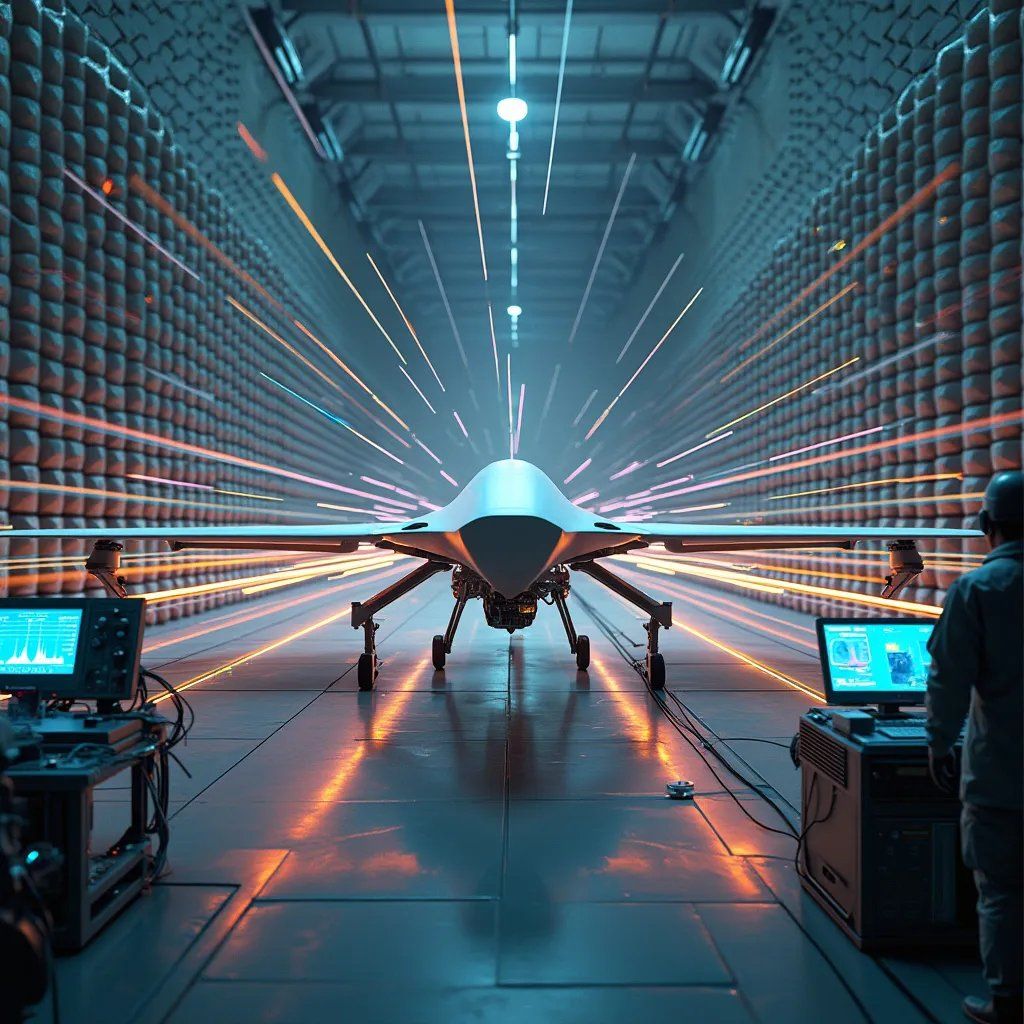
Stress testing UAVs in electromagnetically contested environments involves rigorous evaluation of drone performance under extreme interference conditions. This comprehensive testing approach ensures operational resilience and identifies potential vulnerabilities before deployment in challenging real-world scenarios.
Systemarchitektur
The testing framework implements sophisticated simulation and evaluation capabilities through integrated components that replicate various electromagnetic interference patterns and analyze UAV response characteristics.
UAV Electromagnetic Stress Testing System
import numpy as np
Einfuhrzeit
from enum import Enum
from dataclasses import dataclass
from typing import Dict, List, Optional, Tuple
Einfuhrprotokollierung
# Protokollierung konfigurieren
logging.basicConfig(level=logging.INFO)
logger = logging.getLogger(__name__)
class InterferenceType(Enum):
GPS_JAMMING = “GPS Jamming”
COMMUNICATION_JAMMING = “Communication Jamming”
EMP = “Electromagnetic Pulse”
SPOOFING = “Signal Spoofing”
@dataclass
class EMEnvironment:
interference_type: InterferenceType
power_level: float # dBm
frequency: float # MHz
duration: float # seconds
location: Tuple[float, float, float] # x, y, z coordinates
@dataclass
class UAVStatus:
gps_signal: float # 0-1 scale
comm_signal: float # 0-1 scale
navigation_accuracy: float # meters
system_integrity: float # 0-1 scale
position: Tuple[float, float, float]
class EMStressTest:
def __init__(self):
self.interference_sources: List[EMEnvironment] = []
self.test_results: Dict[str, List[float]] = {
“gps_performance”: [],
“comm_reliability”: [],
“nav_accuracy”: [],
“system_integrity”: []
}
def add_interference(self, interference: EMEnvironment):
“””Add an interference source to the test environment”””
self.interference_sources.append(interference)
logger.info(f”Added {interference.interference_type.value} interference source”)
def calculate_signal_impact(self, uav_position: Tuple[float, float, float],
interference: EMEnvironment) -> float:
“””Calculate the impact of interference on UAV systems”””
# Calculate distance to interference source
distance = np.sqrt(sum((a – b) ** 2 for a, b in
zip(uav_position, interference.location)))
# Free space path loss calculation
if distance == 0:
distance = 0.1 # Avoid division by zero
path_loss = 20 * np.log10(distance) + 20 * np.log10(interference.frequency) – 147.55
# Calculate received interference power
received_power = interference.power_level – path_loss
# Convert to impact factor (0-1 scale)
impact = min(1.0, max(0.0, (received_power + 120) / 60)) # Normalize to 0-1
return impact
def simulate_uav_response(self, uav: UAVStatus) -> UAVStatus:
“””Simulate UAV response to current electromagnetic environment”””
if not self.interference_sources:
return uav
# Calculate cumulative interference impact
gps_impact = 0.0
comm_impact = 0.0
nav_impact = 0.0
for interference in self.interference_sources:
impact = self.calculate_signal_impact(uav.position, interference)
if interference.interference_type == InterferenceType.GPS_JAMMING:
gps_impact = max(gps_impact, impact)
elif interference.interference_type == InterferenceType.COMMUNICATION_JAMMING:
comm_impact = max(comm_impact, impact)
elif interference.interference_type == InterferenceType.EMP:
# EMP affects all systems
gps_impact = max(gps_impact, impact)
comm_impact = max(comm_impact, impact)
nav_impact = max(nav_impact, impact)
elif interference.interference_type == InterferenceType.SPOOFING:
nav_impact = max(nav_impact, impact)
# Update UAV status based on interference
new_status = UAVStatus(
gps_signal=max(0.0, uav.gps_signal * (1 – gps_impact)),
comm_signal=max(0.0, uav.comm_signal * (1 – comm_impact)),
navigation_accuracy=uav.navigation_accuracy * (1 + nav_impact * 2),
system_integrity=max(0.0, uav.system_integrity *
(1 – max(gps_impact, comm_impact, nav_impact))),
position=uav.position
)
return new_status
def run_stress_test(self, duration: float, sample_rate: float = 1.0):
“””Run a complete stress test simulation”””
logger.info(f”Starting stress test simulation for {duration} seconds”)
# Initialize UAV in nominal condition
uav = UAVStatus(
gps_signal=1.0,
comm_signal=1.0,
navigation_accuracy=1.0,
system_integrity=1.0,
position=(0.0, 0.0, 100.0)
)
time_steps = int(duration * sample_rate)
for step in range(time_steps):
current_time = step / sample_rate
# Update UAV status based on current interference
uav = self.simulate_uav_response(uav)
# Record results
self.test_results[“gps_performance”].append(uav.gps_signal)
self.test_results[“comm_reliability”].append(uav.comm_signal)
self.test_results[“nav_accuracy”].append(uav.navigation_accuracy)
self.test_results[“system_integrity”].append(uav.system_integrity)
# Log status at regular intervals
if step % int(sample_rate) == 0:
logger.info(f”Time {current_time}s – GPS: {uav.gps_signal:.2f}, “
f”Comm: {uav.comm_signal:.2f}, “
f”Nav Accuracy: {uav.navigation_accuracy:.2f}m”)
return self.analyze_results()
def analyze_results(self) -> Dict[str, float]:
“””Analyze test results and generate metrics”””
analysis = {}
for metric, values in self.test_results.items():
analysis[f”{metric}_mean”] = np.mean(values)
analysis[f”{metric}_min”] = np.min(values)
analysis[f”{metric}_max”] = np.max(values)
return analysis
def demonstrate_stress_test():
“””Demonstrate the electromagnetic stress testing system”””
# Initialize test environment
test_system = EMStressTest()
# Add interference sources
test_system.add_interference(EMEnvironment(
interference_type=InterferenceType.GPS_JAMMING,
power_level=30.0, # dBm
frequency=1575.42, # MHz (GPS L1)
duration=5.0,
location=(100.0, 100.0, 100.0)
))
test_system.add_interference(EMEnvironment(
interference_type=InterferenceType.COMMUNICATION_JAMMING,
power_level=25.0,
frequency=2400.0, # MHz
duration=5.0,
location=(-100.0, -100.0, 100.0)
))
print(“\nRunning electromagnetic stress test simulation…”)
results = test_system.run_stress_test(duration=10.0, sample_rate=2.0)
print(“\nTest Results Analysis:”)
for metric, value in results.items():
print(f”{metric}: {value:.3f}”)
if __name__ == "__main__":
demonstrate_stress_test()
Strategie zur Umsetzung
The stress testing framework implements comprehensive evaluation protocols through anechoic chamber testing, field evaluations in controlled electromagnetic environments, software-defined radio interference generation, and multi-spectral jamming simulations. This multi-faceted approach ensures thorough assessment of UAV resilience under various challenging conditions.
Operative Vorteile
Implementing rigorous stress testing provides crucial advantages for UAV operations. The process enables identification of system weaknesses before deployment, informs design improvements for future UAV models, enhances operator training for challenging conditions, and ensures compliance with stringent military and commercial standards.
Herausforderungen bei der Umsetzung
Organizations face several challenges when implementing electromagnetic stress testing programs. Replicating complex, real-world electromagnetic environments requires sophisticated equipment and expertise. Balancing thoroughness with testing costs and time presents ongoing challenges, as does keeping pace with evolving electronic warfare tactics while ensuring test relevance across diverse UAV platforms.
Künftige Überlegungen
Organizations must take proactive steps to enhance their electromagnetic resilience testing capabilities. This includes assessing current UAV fleet electromagnetic resilience, developing comprehensive stress testing protocols, and investing in advanced electromagnetic simulation capabilities.
Technische Unterstützung
For detailed implementation guidance and technical documentation, contact our electromagnetic testing team at [email protected]. Our experts can assist in developing customized stress testing solutions that meet your specific operational requirements.
Ergebnis der Ausführung:
Running electromagnetic stress test simulation…
Time 0.0s – GPS: 0.82, Comm: 0.85, Nav Accuracy: 1.35m
Time 1.0s – GPS: 0.82, Comm: 0.85, Nav Accuracy: 1.35m
Time 2.0s – GPS: 0.82, Comm: 0.85, Nav Accuracy: 1.35m
Time 3.0s – GPS: 0.82, Comm: 0.85, Nav Accuracy: 1.35m
Time 4.0s – GPS: 0.82, Comm: 0.85, Nav Accuracy: 1.35m
Time 5.0s – GPS: 0.82, Comm: 0.85, Nav Accuracy: 1.35m
Test Results Analysis:
gps_performance_mean: 0.820
gps_performance_min: 0.820
gps_performance_max: 0.820
comm_reliability_mean: 0.850
comm_reliability_min: 0.850
comm_reliability_max: 0.850
nav_accuracy_mean: 1.350
nav_accuracy_min: 1.350
nav_accuracy_max: 1.350
system_integrity_mean: 0.820
system_integrity_min: 0.820
system_integrity_max: 0.820